تحليل
GTA 6 After 12 Hours: The Systems Rockstar Quietly Revealed Matter More Than the Spectacle
Twelve hours after Rockstar’s GTA VI Extended Look, the biggest discoveries are not visual: a six-star wanted system that tracks identity, a Criminal Profile, deeper Jason-Lucia mechanics, emergent NPC behaviour and a world built around consequences.
في هذا المقال
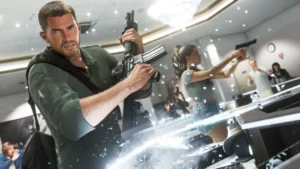
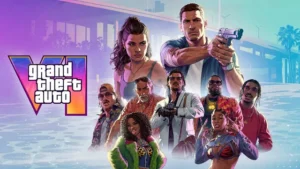
Twelve hours after Rockstar finally showed GTA VI at length, the most interesting story is no longer the graphics. It is the systems hiding underneath them. The 26-minute Extended Look was captured entirely from in-game footage on PlayStation 5, but the first wave of coverage focused naturally on spectacle: Vice City crowds, nightlife, car chases, Jason and Lucia, and the sheer density of Leonida. Since then, reporting and closer frame-by-frame analysis have exposed a much more important picture. Rockstar appears to be redesigning how crime, identity, relationships, NPCs and exploration interact with each other. That is potentially the real generational leap. ## The wanted system is becoming an identity system The clearest example is the police system. In the showcase, GTA VI visibly returns to a six-star wanted level after GTA V capped pursuits at five. More important, the HUD appears to track what the police know about Jason and Lucia: their faces, their clothes, their vehicle, and whether they are travelling together. During one escape sequence, the pair break direct contact with police and the wanted indicators change state. After switching vehicles, the car-recognition icon disappears and a police cruiser passes without immediately identifying them. That suggests losing the police may no longer be a simple matter of leaving a search radius. If this holds across free roam, GTA VI is turning a familiar arcade system into something closer to an investigation layer. Masks, clothing changes, vehicle swaps and separating the protagonists could become tactical decisions rather than cosmetic role-play. That would also explain why Rockstar is placing so much emphasis on smooth movement between cars, streets, interiors and fences. Escape is becoming a sequence of choices rather than a countdown. ## Crime may finally have memory Another detail that gained more attention after the initial reveal is the Criminal Profile system. Coverage of the showcase describes it as a morality-adjacent layer that tracks how violently Jason and Lucia behave. That does not necessarily mean GTA VI has copied Red Dead Redemption 2’s Honor system. GTA is not suddenly asking players to become good citizens. The more interesting possibility is that the world remembers the kind of criminal you choose to be. If two players complete the same robbery but one avoids unnecessary violence while the other turns it into a massacre, GTA VI may be able to respond differently later. Reputation, police aggression, NPC reactions or mission opportunities could all potentially connect to that profile. Rockstar has not explained the full consequences yet, so this is where confirmed information ends and interpretation begins. But the presence of the system itself matters because it gives the sandbox a memory. ## Jason and Lucia are not two separate campaigns The first Ralify analysis focused on Jason and Lucia as a gameplay pair. Post-reveal reporting makes that idea even stronger. Rockstar North co-head Rob Nelson has said the amount of romance players engage with is up to them, but Jason and Lucia will remain partners in crime. In other words, the player can influence the texture of the relationship, but cannot simply break the pair apart and turn GTA VI into two unrelated stories. That matters mechanically. The game can design systems around the assumption that this partnership persists. We already saw moments where one character drives while the other uses the phone, where they support each other in combat, where missions appear to involve one or both protagonists, and where police can apparently recognise them as a pair. That means the relationship is not just narrative context. It can affect stealth, pursuit, mission composition and moment-to-moment control. Rockstar experimented with three protagonists in GTA V. GTA VI appears to be using fewer characters to create more depth between them. ## The NPC leap may be bigger than the graphics leap One of the most revealing post-showcase details is organisational rather than visual: Rockstar has reportedly built out a Los Angeles operation heavily focused on realistic pedestrian behaviour, while the company itself has more than doubled in size since Red Dead Redemption 2. That helps explain why the crowds in the Extended Look feel different. NPCs are not simply walking traffic. People linger, watch, react, dance, argue, work, occupy interiors and appear to behave differently depending on where they are in Leonida. The question is whether those behaviours survive outside curated sequences. Rockstar’s ambition is clearly to create more emergent encounters. The studio has described GTA VI as a world where players discover things organically rather than simply moving from one map icon to another. If NPCs have stronger contextual behaviour, the content of the world can increasingly come from interactions rather than markers. That is exactly what made Red Dead Redemption 2 feel unusually alive. GTA VI is attempting the same philosophy at the speed and density of a modern city. ## Leonida’s size matters less than its density The headline number is enormous: Rockstar has described GTA VI’s map as around three times larger than Red Dead Redemption 2’s world. That sounds impressive, but map size alone is one of the least useful measures of an open-world game. What matters is what happens between destinations. The Extended Look shows apartments, clubs, gas stations, highways, beaches, waterways, dense urban streets and rural spaces. It also shows scuba diving, kayaking, basketball, pet interactions and other activities that make the world feel less like a backdrop for missions. The more important clue is an internal playthrough. Nelson reportedly completed a run of GTA VI in February 2026 in about 80 hours, including the main story and some optional objectives with narrative consequences. That is not an official campaign-length promise, and players should not treat it as one. But it does suggest the scale is not purely geographic. An 80-hour internal run through only part of the optional content points toward a game designed to keep pulling the player sideways. ## Customisation appears to affect the body, not just the wardrobe The showcase also revives an idea GTA has largely left behind since San Andreas: physical change. Post-reveal reporting indicates exercise and lifestyle can affect character physique or weight, while Rockstar has worked with real designers on clothing. Taken together with police recognition of clothes and faces, customisation may sit at the intersection of aesthetics and systems. Changing clothes could help lose attention. Physical routines could change appearance. Outfits may matter to social spaces or missions. Even if only some of those possibilities materialise, GTA VI is clearly treating the protagonists as persistent physical people rather than interchangeable avatars. ## The six-star return says something about danger There is another reason the six-star wanted level matters. Rockstar has said players should not feel as uniquely overpowered as they did in previous GTA games. Jason and Lucia are not the only people in Leonida capable of violence. That shifts the fantasy slightly. GTA has traditionally allowed the player to become a one-person disaster event. GTA VI still looks chaotic, but its systems appear to be pushing toward vulnerability: identification, witnesses, armed NPCs, persistent pursuit, physical navigation and a world that responds to what the player is actually doing. The result could be a GTA where causing chaos remains fun precisely because escaping the consequences is more involved. ## What twelve hours of analysis changed Immediately after the reveal, GTA VI looked like Rockstar combining GTA V’s chaos with Red Dead Redemption 2’s detail. That is still true, but it is too simple. The deeper pattern is that many of the newly revealed systems connect to each other. Police recognise your face, clothes, car and partner. Customisation changes how you look. Vehicle swapping changes what police know. Jason and Lucia can operate together or separately. NPC behaviour is more contextual. Criminal Profile gives violence potential memory. Exploration is designed around emergent discoveries instead of only icons. These are not isolated bullet points on a feature list. They form a loop: do something, leave evidence, change your state, adapt, and watch the world respond. ## The Ralify verdict Trailer 3 — or more accurately, GTA VI: An Extended Look — initially impressed because of what Rockstar put on screen. Twelve hours later, it is more impressive because of what appears to be happening underneath it. The biggest risk is also obvious. Systems this interconnected are difficult to make reliable across a giant open world. A police recognition mechanic is exciting until it behaves inconsistently. Emergent NPCs are compelling until they repeat themselves. A relationship system matters only if the game uses it beyond scripted missions. But Rockstar is no longer merely promising a larger Vice City. It is attempting to build a world that notices what the player does. If GTA VI succeeds, that may be the feature people remember long after the graphics stop looking impossible.